
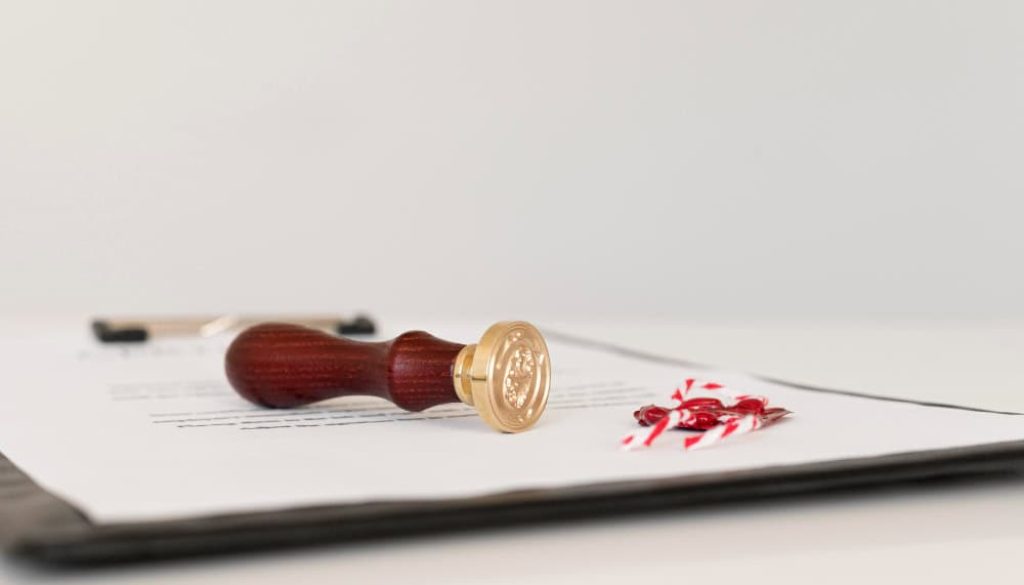
Visual elements in legal translation
In legal translation, precision extends beyond the written word.
When we fail to account for non-textual elements like stamps, seals, and coats of arms, courts, embassies, or government agencies can reject the document.
And that’s why expert translators treat these visual markers with serious attention.
1. Establishing authenticity and jurisdiction
Legal documents derive their power from the authority that issues them. A coat of arms or a government logo identifies the specific jurisdiction and department involved.
We must describe these elements (e.g., [Official Seal of the State of…]) to prove the document’s source. This allows the receiving official to verify that the person signing had the legal power to do so.
When these details are omitted, the document looks like a mere draft rather than an enforceable legal instrument.
2. Capturing the “invisible” text
Stamps and seals often contain the most critical information in a legal process. They reveal dates of filing, notary commission expiry dates, and registration numbers.
Translation protocol: If a rubber stamp appears smudged or partially illegible, we should note this fact (e.g., [illegible ink stamp]). This transparency protects us and our client by reflecting the exact state of the original evidence.
Signatures: While we cannot “translate” a signature, we must acknowledge its presence with a placeholder like [Signature]. This confirms that someone executed the document and that we’re not working with an unsigned copy.
3. Maintaining the logical flow
Legal documents are frequently a series of layers. A base document gets a signature, then a notary stamp, and finally an apostille or a legalization seal.
4. Professionalism and court standards
A high-quality legal translation should mirror the structure of the original.
The goal is ease of use for the reader. When a judge or a lawyer compares the original with the translation, they should find the corresponding information instantly.
When we use clear, bracketed descriptions for visual elements, we ensure that the translation functions as a faithful “twin” of the source.
Image: Freepick