
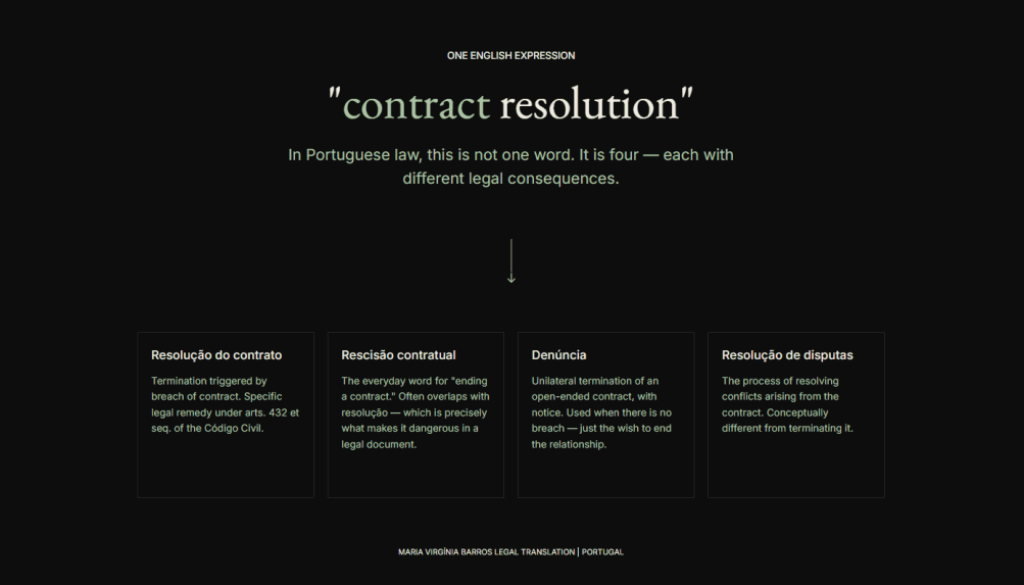
One Word, Two Legal Worlds
Your contract says one thing. The Portuguese version might say something else entirely.
Why machine translation and AI tools are not enough for legal documents — and what one single word can cost you.
Contracts get sent to Google Translate every day. Then to DeepL. Then, sometimes, to an AI assistant. The result comes back in seconds, it reads well enough, and nobody questions it.
Until someone does.
I have spent 20 years in international business — negotiating contracts, managing tenders across languages, sitting in rooms where a mistranslation could unravel months of work. What I know from that experience is this: a translated legal term can be grammatically perfect and legally wrong. The job is finding the right concept in a completely different legal system.
That is a problem no machine has learned to solve.
Two legal systems, one document
Before a translator writes a single word, they must understand what legal world the original document comes from — and what legal world the translation must work inside.
English-language contracts are typically drafted under common law: a system built on precedent, on case law, on judicial interpretation. English legal concepts carry meaning accumulated over centuries of court decisions. Portuguese law, by contrast, is Roman-based civil law — a codified system where rights and obligations derive from statute, and where terms have precise, legislated meanings.
These are not parallel tracks. They are different systems of thought. A concept that exists in common law may have no direct equivalent in civil law, and vice versa. The translator’s first job — before looking up a single word — is to understand what the original term means in its own legal framework, and then find its functional equivalent in the target system. Not its literal equivalent. Its functional one.
A machine does not do this. It finds the most statistically likely word match. And in legal translation, the most common word is rarely the legally correct one.
_____________________________________________________________________________
The most common word is rarely the legally correct one.
_____________________________________________________________________________
One word, four possible translations — and only one is right
Consider the English expression “contract resolution.” It appears in agreements constantly. A machine translator will produce something reasonable-sounding in Portuguese. The problem is that in Portuguese law, there are at least four distinct terms that could, in some sense, correspond to this expression — and each one carries a different legal meaning and a different set of consequences.
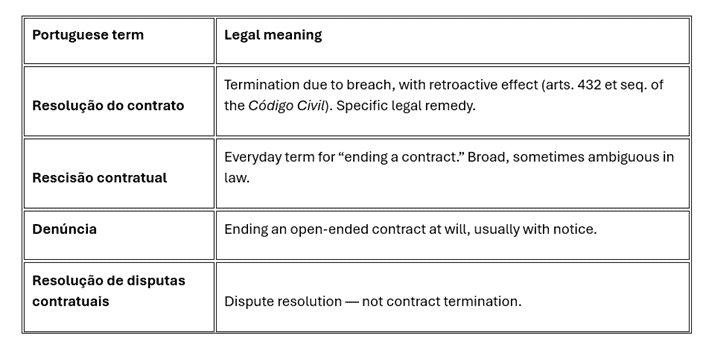
Portuguese terms and legal meaning
THE RISK OF PLAIN TERMS
A contract that uses resolução when it means denúncia — or reaches for rescisão because it sounds right — may not be enforceable as intended. A Portuguese court, or a Portuguese counterparty’s lawyer, will read the term according to its legal meaning in the Código Civil. If the wrong term is there, the document does not say what you think it says.
Machine translation does not know the difference between these terms in context. It does not know whether the original clause refers to ending a contract after a breach, ending it at will, or resolving a dispute that arose from it. It finds the most frequent translation and moves on.
A human translator with legal training reads the clause, identifies what it is legally doing, and selects the Portuguese term that performs the same legal function. Those are two entirely different processes.
False friends, real consequences
The “resolution” example is not unusual. It is representative of how legal language works — and of why legal translation demands a different skill set than any other kind of translation.
Legal terms are false friends by nature. They look like they correspond across languages. In many cases they do not, because they live in different legal systems with different rules, different court interpretations, and different consequences when invoked.
The word “resolution” appears in your contract. You send it to DeepL. DeepL returns something that looks like Portuguese. Your Portuguese counterpart’s lawyer reads it. And the clause now means something different from what you intended — or, worse, it is ambiguous enough to become a point of dispute.
That is not a translation problem. That is a liability problem.
What professional legal translation actually involves
Before translating a single sentence, I research the legal context: what jurisdiction does this contract sit in, what type of relationship does it govern, what legal consequences attach to each key term? That research takes time — and it is time that protects your interests.
Then I work through the document not word by word, but concept by concept. For each term, I ask: what does this mean in its legal system of origin, and what is its functional equivalent in Portuguese law? Sometimes the equivalent exists. Sometimes it does not, and the translator must choose the closest term and flag the gap — so that legal counsel can address it explicitly.
A machine translator skips every one of those steps. It produces a fluent text that reads confidently and may be legally wrong in ways that are invisible until tested.
_____________________________________________________________________________
Fluent is not the same as correct. In a contract, the difference matters.
Your contracts should work as well in Lisbon as they do in London. That requires more than translation. It requires someone who understands both legal worlds — and knows which word to choose when the easy answer is the wrong one.